
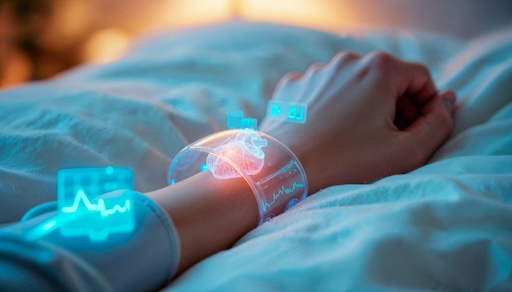
From tracking health data to delivering personalized insights, AI is helping businesses build the next generation of intelligent healthcare applications.
Smartwatches have evolved from simple fitness trackers into powerful wearable devices capable of collecting a wide range of health and activity data. Depending on the device, this can include heart rate, sleep, activity, workouts, movement, heart-rate variability and other health-related measurements.
But collecting data is only the beginning.
The bigger opportunity is to use AI to understand that data and turn it into meaningful, personalized insights.
At iCodeBees, we help businesses build AI-powered healthcare applications that connect wearable data with mobile applications, APIs, cloud platforms and intelligent AI services.
From Smartwatch Data to Intelligent Insights
A traditional smartwatch application might show:
- Heart rate
- Sleep duration
- Steps
- Calories
- Workout activity
- Other available health metrics
Users can see the numbers, but they still need to interpret what they mean.
An AI-powered application can analyze these measurements over time and identify meaningful patterns.
For example:
“Your average sleep has decreased over the last week, while your resting heart rate has increased compared with your recent baseline.”
This changes the experience from:
Collecting Data → Displaying Data
to:
Collecting Data → Analyzing Data → Understanding Patterns → Providing Personalized Insights
This is where AI can make wearable healthcare applications significantly more valuable.
Why AI Is Important for Wearable Healthcare
Wearable devices can generate large amounts of information. Manually analyzing all of this data isn’t practical for most users.
AI can help applications process and interpret this information.
Personalized Health Insights
AI can analyze an individual’s historical data and provide insights based on their own patterns rather than generic recommendations.
Trend Analysis
Instead of focusing on one measurement, AI can identify changes over days, weeks or months.
For example, an application could analyze relationships between:
Sleep + Activity + Heart Rate + Exercise
and present the results in a simple, understandable format.
AI Health Assistants
Users can interact with their authorized health information using natural language.
For example:
“How has my sleep changed this month?”
or:
“Show me my activity trend over the last four weeks.”
An AI assistant can retrieve the relevant information, analyze it and provide a conversational response.
Personalized Recommendations
Depending on the application’s intended use, AI can support personalized recommendations around fitness, activity, sleep and wellness.
Remote Health Monitoring
Wearable data can also become part of remote patient monitoring solutions, where healthcare professionals can access relevant information through secure dashboards and applications.
How We Can Build an AI-Powered Wearable Healthcare App
Businesses don’t necessarily need to develop their own smartwatch or wearable device.
Instead, applications can integrate with supported health-data ecosystems and wearable APIs.
A typical architecture could look like:
Smartwatch / Wearable
↓
Apple Health / Android Health Connect / Supported APIs
↓
iOS / Android Application
↓
Secure Backend & APIs
↓
Healthcare Data Platform
↓
AI & Analytics Layer
↓
Personalized Healthcare Experience
iCodeBees can develop the application, backend, API, cloud and AI layers around supported wearable ecosystems.
Technology Stack
Building an AI-powered wearable healthcare application requires multiple technologies working together.
Wearable & Health Data Integration
Applications can connect with supported platforms such as Apple HealthKit, Android Health Connect, Apple Watch, Wear OS, Fitbit and Garmin APIs.
These integrations allow applications to access authorized health and activity data without requiring the business to manufacture its own wearable device.
Mobile Application Development
The mobile application can act as the bridge between wearable ecosystems and the healthcare platform.
iCodeBees can develop iOS, Android and cross-platform applications using technologies such as:
Swift, Kotlin, Flutter and React Native
Applications can include health dashboards, synchronization, notifications, user profiles and AI-powered interfaces.
Backend & API Development
A secure backend can manage user accounts, permissions, health-data synchronization and communication between different services.
Technologies can include:
Node.js, Python, Laravel, REST APIs, GraphQL, PostgreSQL, MySQL and Redis
The technology selection depends on the project’s requirements and architecture.
AI & Machine Learning
AI becomes the intelligence layer of the application.
Depending on the use case, technologies can include:
OpenAI, Google Gemini, Azure AI, machine learning, NLP, LLMs, predictive analytics and recommendation models.
These technologies can support health-data analysis, conversational experiences, personalization and intelligent workflows.
AI Agents & RAG
For applications requiring conversational healthcare assistants, technologies such as LangChain, LangGraph and OpenAI Agents SDK can be incorporated.
RAG can also connect AI applications with approved healthcare information, documentation and knowledge bases using embeddings, vector databases and semantic search.
Cloud & Data Infrastructure
Wearable applications can generate significant volumes of data. Cloud infrastructure provides the scalability required to securely process and store this information.
Depending on the project, we can work with:
AWS, Microsoft Azure, Google Cloud and DigitalOcean
along with technologies such as Docker, Kubernetes, CI/CD, cloud databases, object storage, monitoring and observability.
Security, Privacy & HIPAA
Healthcare applications can process highly sensitive information, so security needs to be considered from the beginning.
Depending on the application and target market, the architecture can incorporate:
- Secure authentication and authorization
- OAuth
- Role-based access control
- Encryption
- Secure API communication
- Consent management
- Audit logging
- Data access controls
- Secure cloud infrastructure
- Backup and recovery
For applicable US healthcare applications, the solution can also be designed with HIPAA requirements in mind.
HIPAA applicability depends on factors such as the organization, its role, the data being processed and the intended use of the application. It should therefore be addressed during architecture and compliance planning.
Healthcare Compliance Considerations
The regulatory requirements for a wearable healthcare application depend significantly on what the software is intended to do.
A wellness application may have different requirements from software intended to diagnose, monitor or treat a medical condition.
Depending on the project, organizations may need to consider:
- ISO 13485
- EU MDR
- Software lifecycle processes
- Risk management
- Verification and validation
- Testing and traceability
- Technical documentation
- Cybersecurity
- Clinical evaluation
At iCodeBees, we can provide software engineering, QA and technical documentation support for organizations working through healthcare software and regulatory processes.
What iCodeBees Can Build
Our capabilities cover the major technology layers required for an AI-powered wearable healthcare solution:
- iOS & Android applications
- Wearable & health-data integrations
- Apple Health & Android Health Connect
- Healthcare APIs & backend systems
- AI/ML & NLP
- LLM-powered healthcare assistants
- RAG & AI applications
- Healthcare dashboards
- Data analytics
- Cloud & DevOps
- Security-focused architecture
- QA and testing
- Technical documentation
- HIPAA-focused technical architecture where applicable
- Healthcare compliance support
- Technology resource augmentation
Beyond the Smartwatch: Building an Intelligent Healthcare Platform
The smartwatch itself is only one part of the solution.
The bigger opportunity is to connect:
Wearables + Mobile + Health Data + APIs + Cloud + AI
into a single intelligent healthcare platform.
For example, a future healthcare application could combine wearable information with user-provided information, healthcare records or other approved data sources and use AI to help users understand their overall health trends.
This creates opportunities for:
- Fitness and wellness platforms
- Preventive health applications
- Remote patient monitoring
- Elderly care solutions
- Corporate wellness platforms
- AI healthcare assistants
- Digital health startups
- Healthcare technology providers
The Future of Wearable Healthcare
Smartwatches are already capable of collecting valuable health information.
The next stage is making that information intelligent, personalized and useful.
AI can help transform wearable applications from simple dashboards into intelligent healthcare experiences that can understand patterns, answer questions and provide personalized insights.
The opportunity isn’t necessarily to build another smartwatch.
It is to build the software and intelligence around the wearable ecosystem.
At iCodeBees, we combine AI, mobile development, healthcare software, APIs, cloud engineering and data technologies to help businesses turn wearable data into intelligent digital health solutions.
Building an AI-Powered Healthcare or Wearable Application?
Talk to iCodeBees about your healthcare, wearable, AI and software engineering requirements.

